
How ratings work
ePegboard uses standard Elo for team doubles. Ratings update game by game and feed back into the picker so future games stay competitive. Three things are worth knowing about how the numbers move.
Three things worth knowing
Section titled “Three things worth knowing”- Score matters, not just who won. A 21-19 nail-biter moves ratings far less than a 21-3 walkover. Beating a stronger team convincingly moves you more than scraping past them.
- New players’ ratings move fast, then settle. Your rating swings a lot per game at first, while the system is still learning where you sit, and a Settling marker sits beside it to say so. The marker clears once you have 15 rated games - usually a few sessions in. The swings keep shrinking after that, and stop shrinking at 47 games, where your rating moves as little as it ever will: one game at a time. This is by design: a meaningful ladder should not be moved by a single result once you have settled.
- Both teammates get the same share of the team result. The system does not try to attribute individual contribution within a doubles game (no one is tracking who hit the winning shot). Each player’s actual point change is then scaled by their own settling-in factor, so a brand-new player paired with a settled partner will see a much bigger swing per game from the very same result.
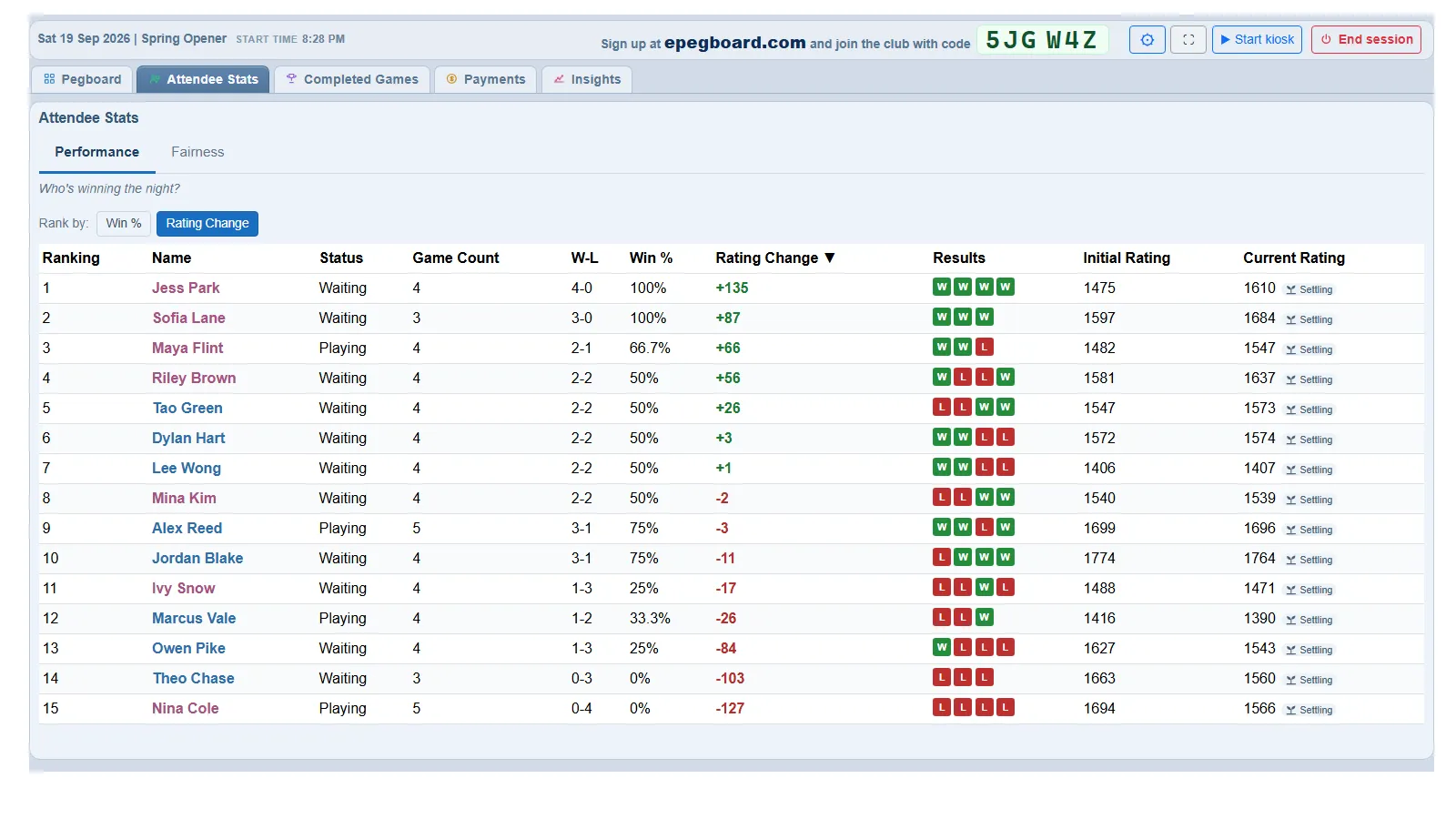 Rating change in action during a session. Note the “Settling” markers next to players who have not yet reached 15 rated games - their ratings move faster until they settle.
If you want the actual maths - the formula, the K-factor schedule and worked examples - it is on a separate page: How a rating change is calculated. We publish the whole thing; nothing is hidden.
Why small clubs get a meaningful ladder fastest
Section titled “Why small clubs get a meaningful ladder fastest”Counter-intuitively, ratings converge faster with a small population. With six regular players you are playing the same five opponents week after week, the settling-in factor is dropping in sync across the group, and the rating order stabilises into a real ladder by month three. Compare with a 300-player club where any individual plays a small sample of the membership in any given season - ratings still settle, just over more elapsed time.
For a group of mates the ladder is the load-bearing value of ePegboard. By the end of a season you have a meaningful answer to “who is actually the best of us this year” backed by every game you played - the kind of thing that is impossible to track by hand and becomes proper banter material when it is automatic.
Starting ratings for a new club
Section titled “Starting ratings for a new club”Six named tiers, matching what the Members page shows when you add or edit a player. Pick the one closest to where each member sits today:
| Tier | Description | Starting rating |
|---|---|---|
| Beginner | Never played / very first session | 400 |
| Recreational | Just starting out, first few sessions | 800 |
| Novice | Plays casually, building basics | 1100 |
| Intermediate | Regular club player (most members) | 1500 |
| Advanced | Club-strong, plays for the challenge | 1900 |
| Expert | County / league level, lifts partners around them | 2300 |
Do not agonise. If you genuinely have no idea, leave everyone at the default 1500 (Intermediate) and the settling-in factor will sort them out over five or six sessions. The tier picker just gives the engine something to work with on the first night, before any real data exists.